

AI agent development has moved out of experimentation and into production. In 2026, companies are no longer asking whether to use AI agents, but which platform to build them on.
The challenge is that the ecosystem is fragmented. Enterprise vendors, developer frameworks, open-source projects, and no-code tools all claim to be “the best” platform for AI agents, yet they solve very different problems.
AI agents are no longer theoretical concepts. They are being actively built, tested, and deployed across real business workflows. This is why understanding what an AI agent actually is, and how it differs from traditional AI tools, matters before choosing a platform.
This guide breaks down the leading AI agent development platforms in 2026, explains where each type fits, and helps you choose the right foundation based on your team, product goals, and technical reality.
Who This Guide Is For
This guide is written for:
- Founders building AI products or agent-based startups
- Product and engineering teams adding AI agents to existing platforms
- Developers choosing between frameworks, APIs, and orchestration layers
- Business leaders evaluating whether to build, buy, or integrate AI agents
If you are deciding where to invest time, budget, and architecture for AI agents in 2026, this is for you.
The Four Types of AI Agent Development Platforms
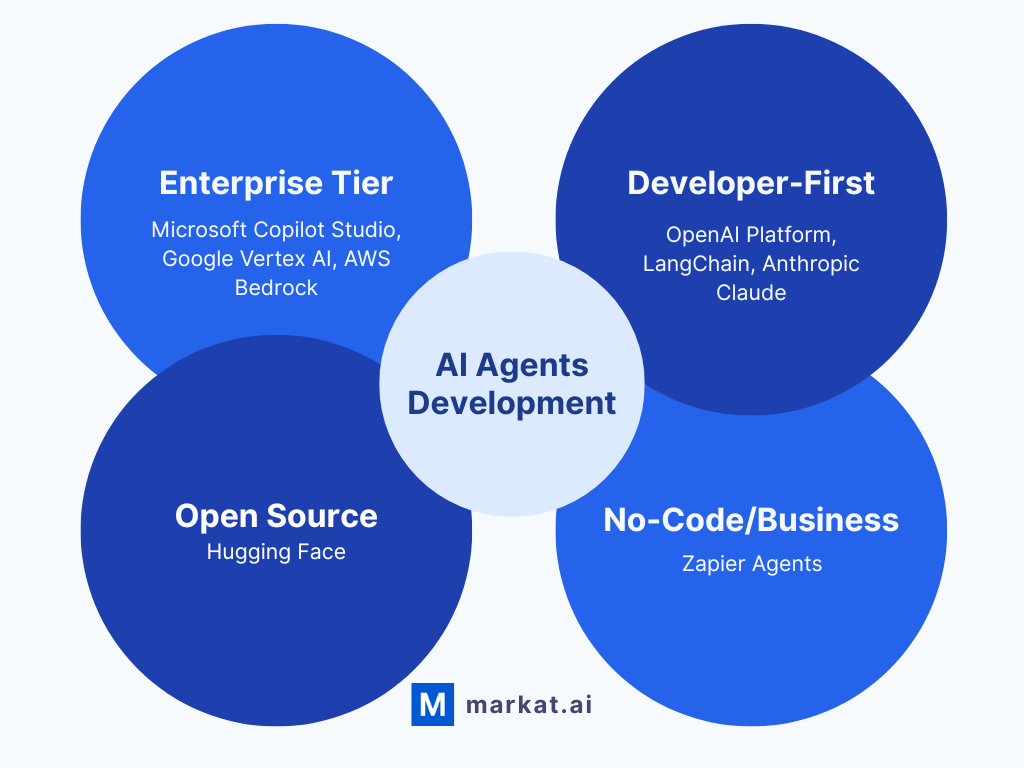
Not all AI agent platforms are built for the same audience. In practice, they fall into four clear categories.
Understanding these categories is critical, because choosing the wrong type creates technical debt, limits scalability, and often forces a rebuild later.
Enterprise Platforms
Examples: Microsoft Copilot Studio, Google Vertex AI, AWS Bedrock
Enterprise platforms are designed for large organisations that need governance, security, and deep integration with existing infrastructure.
They are strong in areas like access control, compliance, data residency, and enterprise support. They work well when AI agents must operate inside regulated environments or connect tightly with internal systems.
AWS Bedrock is designed for regulated and security-sensitive environments where infrastructure control and compliance are critical.
The trade-off is speed and flexibility. These platforms are powerful, but heavier to configure and less forgiving for experimentation.
Best for: large organisations, regulated industries, complex internal systems
Trade-off: slower iteration and higher setup overhead
Developer-First Frameworks
Examples: OpenAI Platform, LangChain, Anthropic, CrewAI, AutoGen
Developer-first frameworks focus on flexibility and control. They allow teams to design agent logic, multi-agent workflows, memory, and tool use at a low level.
This is where most innovation in multi-agent systems is happening. If you are building a product that depends on custom agent behaviour, orchestration, or reasoning chains, this category is usually the right place. It is also where the difference between ChatGPT and dedicated AI agents becomes clear.
The trade-off is that you need engineering resources. These are not plug-and-play tools.
Best for: startups, product teams, advanced use cases
Trade-off: requires technical expertise and ongoing maintenance
Open Source Platforms
Examples: Hugging Face ecosystem, open-source agent frameworks, Meta Llama stack
Open-source platforms give you full control over the stack. They are attractive for teams that want to avoid vendor lock-in, optimise cost, or deeply customise models and behaviour.
They are also common in research and experimental environments.
The trade-off is operational complexity. You own the infrastructure, scaling, security, and reliability.
Best for: teams with strong engineering capability and specific constraints
Trade-off: higher operational responsibility
No-Code and Low-Code Platforms
Examples: Zapier Agents, Relevance AI, Peltarion
No-code and low-code platforms aim to make AI agents accessible to non-developers. They focus on speed, UI-driven workflows, and quick wins for business users.
They work well for simple automation and internal processes. They are not designed for complex reasoning or multi-agent orchestration.
Best for: SMBs, operations teams, fast pilots
Trade-off: limited flexibility and depth
How to Choose the Right AI Agent Platform in 2026
Choosing an AI agent platform is not about features. It is about fit.
Before committing, you should be clear on the following.
No-Code Speed vs Developer Control
If you need fast results and have limited technical resources, no-code platforms can get you moving quickly.
If you are building a product or complex workflow, developer frameworks give you control that no visual builder can match.
There is no universal best choice. There is only what fits your team and roadmap.
Integration Capabilities
Your agents will only be as useful as their ability to connect to real systems.
Look closely at how each platform integrates with:
- CRMs
- Databases
- Internal tools
- APIs
- Data warehouses
If integration is fragile or manual, adoption will fail.
Security and Data Privacy
In 2026, security is not optional. Ask:
- Where is data stored?
- Who can access agent memory?
- How are credentials handled?
If the platform cannot answer these clearly, do not use it in production.
Pricing Model
AI agent pricing varies widely. Some platforms charge per agent, some per execution, some per seat.
Make sure you understand how costs scale. A cheap pilot can become expensive very quickly.
Multi-Agent Support
Single agents are useful. Multi-agent systems are transformative.If your use case involves handoffs, parallel tasks, or role-based workflows, ensure the platform actually supports multi-agent orchestration and not just the marketing label. In these scenarios, multi-agent collaboration patterns are becoming the standard.
| Platform | Type | Best For | Strength | Limitation |
|---|---|---|---|---|
| Microsoft Copilot Studio | Enterprise | Internal enterprise workflows | Governance, Microsoft ecosystem integration | Heavy setup, slower iteration |
| Google Vertex AI | Enterprise | Large-scale ML + agents | Scalability, data integration | Complex configuration |
| AWS Bedrock | Enterprise | Regulated and secure environments | Model choice, infrastructure control | Steeper learning curve |
| OpenAI Platform (Agents & API) | Developer-first | Custom agent products | Flexibility, ecosystem momentum | Requires engineering ownership |
| LangChain | Developer-first | Complex agent workflows | Orchestration, modular design | DIY maintenance |
| Anthropic (Claude + tools) | Developer-first | Reasoning-heavy agents | Strong safety + reasoning | Less orchestration tooling |
| CrewAI | Developer-first | Multi-agent role workflows | Simple multi-agent setup | Early-stage ecosystem |
| Hugging Face | Open source | Model experimentation | Control, community | Operational overhead |
| Zapier Agents | No-code | Simple business automation | Speed, integrations | Limited logic depth |
| Relevance AI | Low-code | Internal tools & ops | Business-friendly UX | Less technical flexibility |
Best AI Agent Platforms for Startups and SMBs
Startups and small businesses do not need enterprise infrastructure. They need speed, clarity, and ROI.
The best platforms for this segment are those that:
- Have low setup overhead
- Support rapid iteration
- Do not require large engineering teams
- Offer transparent pricing
In practice, this often means developer-first frameworks combined with lightweight orchestration, or no-code platforms for internal automation.
The key is to start small, validate value, and scale only once results are proven. This is also where understanding how to implement AI agents in real workflows becomes critical.
Where Markat.ai Fits in the AI Agent Ecosystem
Markat.ai is designed to sit between ideas and production, helping teams move from concept to validated agent solutions. If you have already built an agent, the next challenge is distribution, feedback, and iteration.
Instead of committing to a platform or build approach blindly, Markat.ai allows teams to:
- Discover AI agents built for real business problems
- Test agents in practical workflows before scaling
- Validate performance and fit before committing resources
- Provide structured feedback to improve agent quality
This reduces risk, shortens decision cycles, and helps teams avoid expensive mistakes.
In an ecosystem moving as fast as AI agents, testing before committing is no longer optional.
FAQ
What is the best AI agent platform for beginners in 2026?
No-code and low-code platforms are the easiest entry point, but they are limited. For long-term products, developer-first frameworks provide more control and scalability.
What are the best open-source AI agent platforms available today?
Open-source ecosystems such as Hugging Face and AutoGen offer flexibility and cost control, but require strong engineering ownership for deployment and maintenance.
How did the launch of ChatGPT agents change the AI agent platform landscape?
It raised the baseline for usability and awareness, but did not replace the need for dedicated orchestration, integration, and governance platforms.
Can I monetize agents from these platforms?
Yes. Most allow commercial use, and Markat.ai helps you reach users and generate revenue.
Agent platforms vs. general AI tools?
Agent platforms enable autonomous action with guardrails. General AI tools mostly produce outputs that still require manual follow-up.
What is the easiest AI agent platform for beginners?
No-code and low-code platforms are the easiest entry point, but they are limited. For long-term products, developer frameworks are a better foundation.
Are there free or trial AI agent platforms?
Many platforms offer free tiers or trials, but production use usually requires paid plans. Always test before committing.
Do AI agent platforms support multi-agent workflows?
Some do, some do not. Always verify real orchestration support rather than relying on marketing language.
Can I switch platforms later?
Technically yes, but it is costly. Architecture decisions create inertia, so choose carefully.
Conclusion
In 2026, AI agents are not a feature. They are infrastructure.
The platform you choose will define how fast you can build, how far you can scale, and how much flexibility you retain. There is no universal winner. There is only the platform that fits your team, product, and ambition.
Start small. Test aggressively. Scale only what proves value.
That discipline is what separates successful AI products from expensive experiments.
