

Implementing AI agents is not about flipping a switch. It is about assigning clear responsibilities to AI systems within your existing workflows and following a structured process from testing to measurable results.
For small and mid-sized businesses, this matters now more than ever. AI agents are not just for big enterprises. They can save hours on admin, reduce costly mistakes, and give your team back time for the work that really drives growth.
This playbook breaks down how to implement AI agents step by step, with real examples you can apply today.
Why SMBs Should Care
AI agents are no longer experimental. Used correctly, they can:
- Save time on repetitive reporting and data entry.
- Cut costs by reducing manual admin.
- Improve service with faster, more consistent workflows.
- Give small teams leverage. You do not need the headcount of a big competitor if your processes are tighter and smarter.
If you are still relying only on AI tools for single tasks, you are missing out on what AI agents can actually do. Agents go further. They can carry work through entire workflows.
Step-by-Step: How to Implement AI Agents
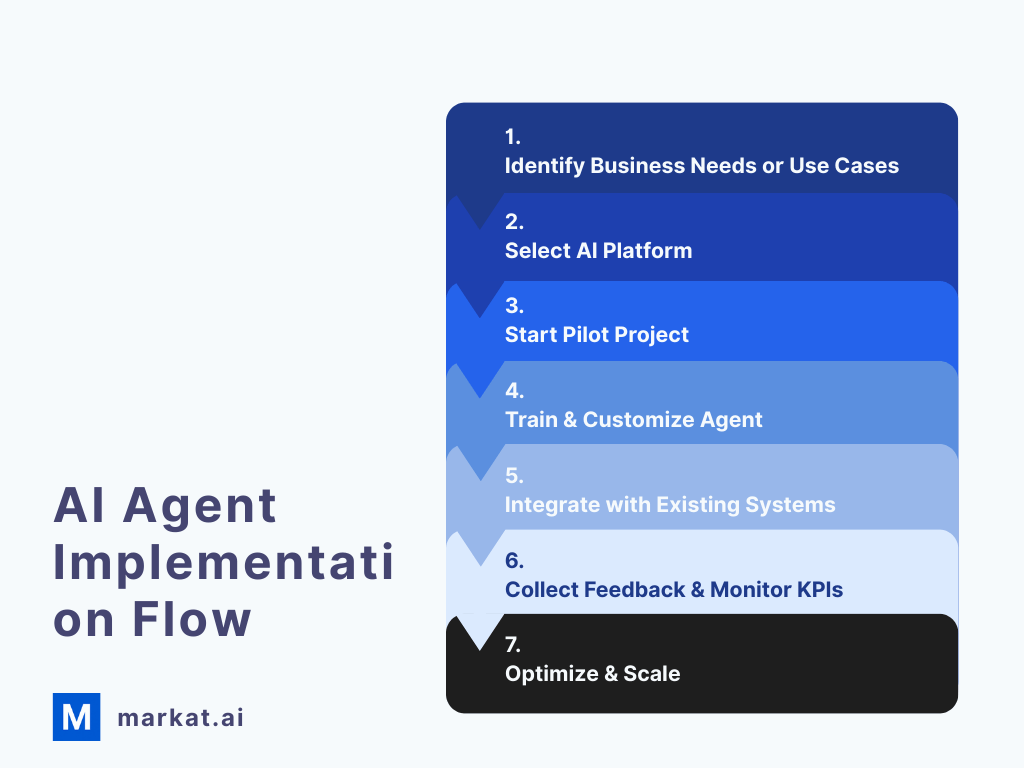
1. Define the Right Use Case
StStart small and focused. The best agents automate repetitive, rule-based tasks that eat up time.
- In healthcare, that might mean generating structured patient summaries after each consultation, freeing medical staff from hours of manual reporting.
- In architectural engineering, an agent could assemble compliance reports or consolidate planning documents across multiple stakeholders and platforms.
Pick a process that is structured, time-consuming, and high-volume. That is where agents shine. Many teams burn budget trying to automate chaos. If the process is broken, an agent will only make it worse. Fix the workflow first.
2. Choose the Right Platform
Not all platforms are built for the same thing. Some are no-code and ready for SMBs, others require developers. Match the platform to your workflow and team skills.
See our full guide: Best Platforms to Develop AI Agents. Enterprise platforms such as Amazon Bedrock also support building and orchestrating agent-based systems using managed models and infrastructure.
3. Pilot with a Narrow Scope
Do not roll out company-wide on day one. Test with a single workflow, one department, or a handful of users.
This keeps risk low and learning high.
4. Measure Real Outcomes
A demo means nothing if you cannot prove value. Measure against hard outcomes:
- In healthcare, does the agent cut patient documentation prep from two hours to twenty minutes?
- In engineering, does it reduce errors or delays in compliance reports that otherwise stall approvals?
If yes, you have proof it is worth scaling.
5. Integrate Into Existing Systems
The best AI agents do not sit on an island. They connect with your CRM, ERP, or reporting tools.
This is where many teams fail. If integration is weak, adoption collapses. This is why testing in a sandbox before rollout is critical.
6. Train Your Team
Even the best agent fails if your team does not trust it. Show them what it does, what it does not do, and how it fits into their workflow.
Team adoption is a human problem, not a technical one.
7. Iterate and Expand
Agents are not set and forget. Use feedback loops to improve performance, fix gaps, and expand into new areas.
Start with one workflow. Add more only once you have proven results.
Pilot vs Full Deployment
| Aspect | Pilot | Full Deployment |
|---|---|---|
| Scope | One workflow | Multiple workflows |
| Cost | Low | Higher upfront |
| Risk | Contained | Broader impact |
| Speed | Fast | Slower, but scalable |
| Best For | Testing value | Scaling proven agents |
Common Challenges (and How to Avoid Them)
- Wrong workflow: Do not start with vague, messy processes. Automating confusion just gives you faster confusion.
- Weak integration: If it does not connect with your systems, it will not last.
- No success metrics: “It feels useful” is not proof. Track time, errors, or costs.
- Team resistance: If people do not trust it, they will not use it.
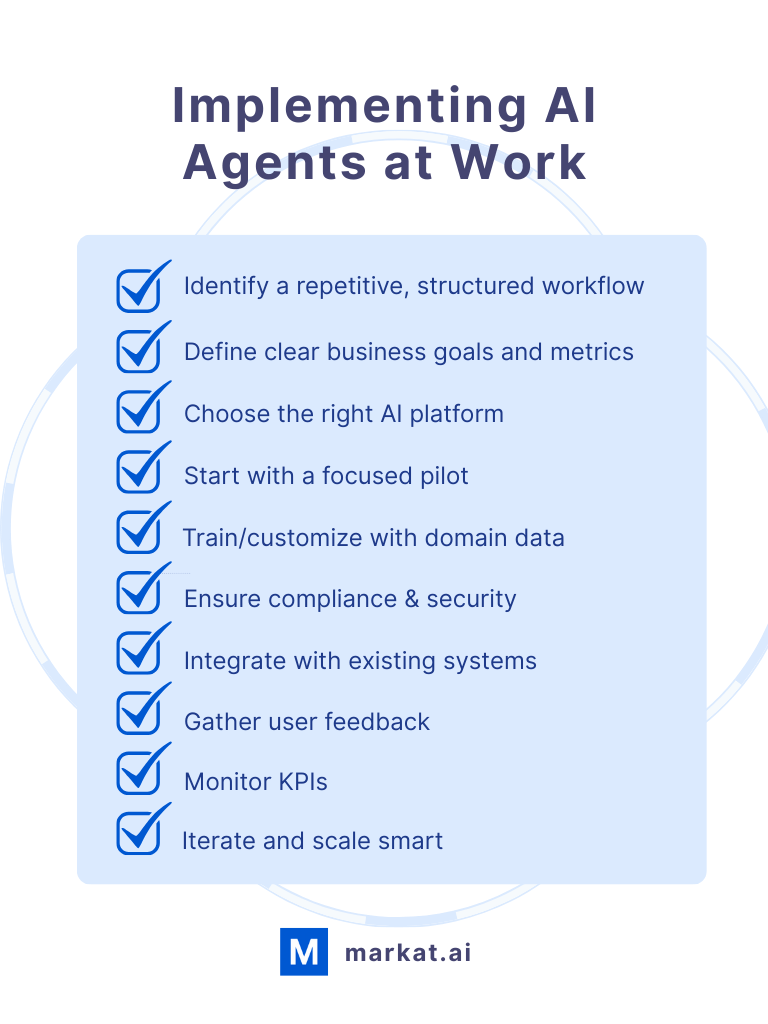
Checklist Before You Roll Out
- The workflow is repetitive and structured.
- Data is clean enough for automation.
- Success metrics are clear.
- A pilot owner is assigned.
- Feedback loops are in place.
If you cannot check these boxes, you are not ready to scale.
Where Markat.ai Fits
At At Markat.ai, we are building a marketplace and sandbox environment where SMBs can test AI agents in real workflows, validate results before scaling, and adopt only what proves value.
This allows businesses to move beyond demos and vendor claims and make decisions based on real performance.
FAQ
How long does it take to implement an AI agent?
A pilot can be live in days. Full rollout usually takes weeks, depending on integration needs.
Do I need developers?
Not always. No-code platforms work well for SMBs, though complex workflows may require technical help.
Can SMBs really afford this?
Yes. Starting with pilots keeps costs low, and proven agents pay for themselves in saved time and reduced errors.
What are the best use cases for AI agents in small businesses?
Customer support, reporting, onboarding, compliance checks, and data processing are the most common and successful starting points.
How much does it cost to implement AI agents in a business?
Costs vary based on platform, complexity, and integration needs. Many SMBs start with low-cost pilots using no-code tools before investing in custom solutions.
Do AI agents need access to internal systems to be useful?
Yes. The highest value comes when agents are integrated with CRMs, ERPs, and internal databases so they can act on real business data.
What are the biggest risks when implementing AI agents?
Poor process design, weak integration, lack of governance, and unrealistic expectations are the most common causes of failure.
Conclusion
Implementing AI agents does not have to be complicated. Start small, measure real outcomes, train your team, and scale only what works.
The companies that succeed are the ones that start small, measure honestly, and scale only when it makes sense.
At Markat.ai, we are building a marketplace to make that journey easier. A place to test, validate, and adopt agents that actually work for your business.