
AI agents are no longer an emerging concept. In 2026, they are actively deployed across products, internal systems, and business workflows.
Despite this adoption, the term “AI agent” is still used loosely. It is often applied to anything from a chatbot to a scripted automation, creating confusion for builders and decision makers who need precision, not abstraction.
This article provides a practical definition of what an AI agent is, what it does, and how it differs from traditional software and AI tools, based on how these systems are actually used in production today.
What Is an AI Agent?
An AI agent is software that can perceive input, make decisions, and take actions autonomously to achieve a defined goal.
Unlike traditional software, an AI agent is not limited to fixed rules or linear workflows. It operates with context, adapts its behavior based on outcomes, and can determine what to do next without continuous human instruction.
The defining difference is autonomy. An AI agent does not simply execute commands. It evaluates situations, chooses actions, and adjusts its approach as conditions change.
AI Agent Definition
An AI agent is a system that perceives its environment, evaluates context, makes decisions, and performs actions autonomously in pursuit of a goal.
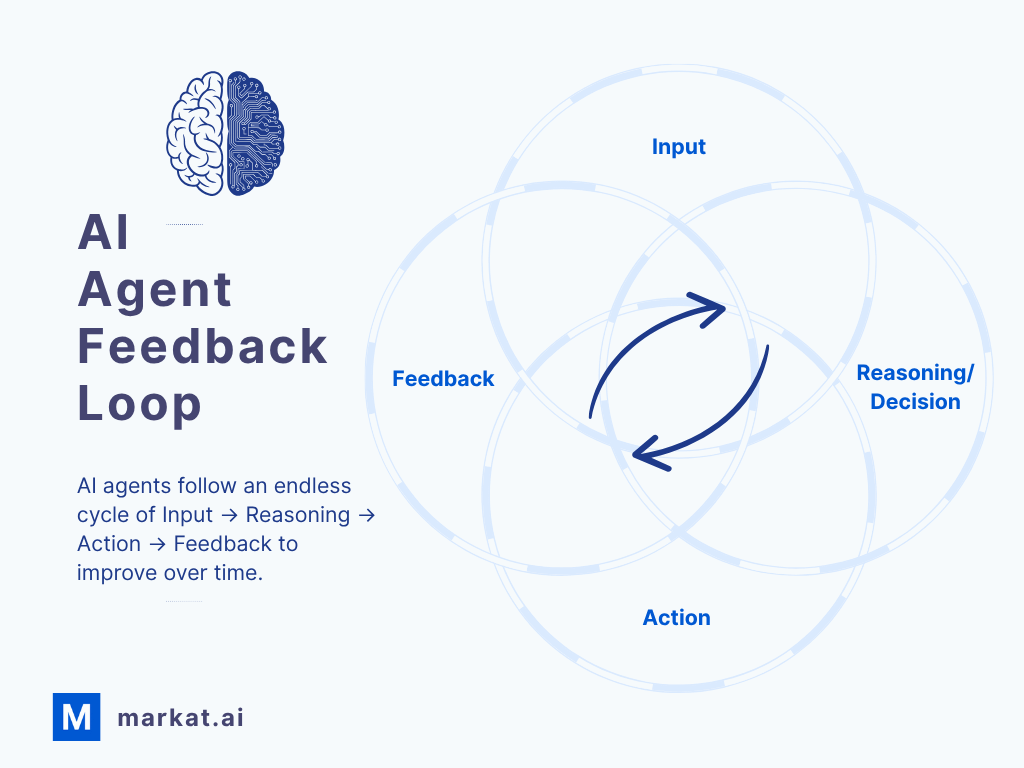
What distinguishes an AI agent is not the model it uses, but its ability to operate independently. Perception, decision making, and action work together in a continuous loop, allowing the system to function without constant human direction.
In Plain Terms
An AI agent is software that can decide what to do next and carry it out on its own.
What Does an AI Agent Do?
An AI agent performs ongoing tasks by observing inputs, making decisions, and executing actions without step-by-step instructions.
In practice, an AI agent can:
- Monitor systems, data, or user behavior in real time
- Decide which action to take based on context and defined goals
- Execute tasks across tools, APIs, or connected systems
- Learn from outcomes and adjust future behavior
- Escalate decisions to humans when confidence or authority is limited
Because of this autonomy, AI agents are suited for continuous operational work rather than one-time interactions or static processes.
The Main Types of AI Agents Used in Practice
While terminology varies, most production AI agents fall into a small number of practical categories. The differences matter because each type is suited to a different level of autonomy, risk, and complexity.
Reactive Agents
Respond immediately to input without memory or learning.
Used when speed and predictability are more important than adaptation, such as simple rule-based responses.
Limited-Memory Agents
Use recent interactions or short-term context to inform decisions.
Common in customer-facing systems where continuity and context improve outcomes.
Tool-Using Agents
Combine AI models with external tools, APIs, or data sources to complete tasks.
Used when agents need to retrieve information, trigger actions, or interact with other systems.
Multi-Agent Systems
Multiple specialized agents coordinate to achieve a shared objective.
Used for complex workflows where tasks can be distributed and parallelized.
Human-in-the-Loop Agents
Operate autonomously but defer critical or ambiguous decisions to humans.
Used in regulated, sensitive, or high-risk environments where oversight is required.
AI Agents vs AI Tools
AI tools assist users. AI agents act on their behalf.
An AI tool responds when prompted and performs a specific task. An AI agent operates continuously, deciding what to do next based on context and objectives.
For example, a text generation tool produces content when asked. An AI agent can decide when content is needed, generate it, publish it, and monitor performance without further input.
If a system requires constant user direction, it is a tool. If it can observe, decide, and act independently toward a goal, it functions as an agent.
Real-World Uses of AI Agents Today
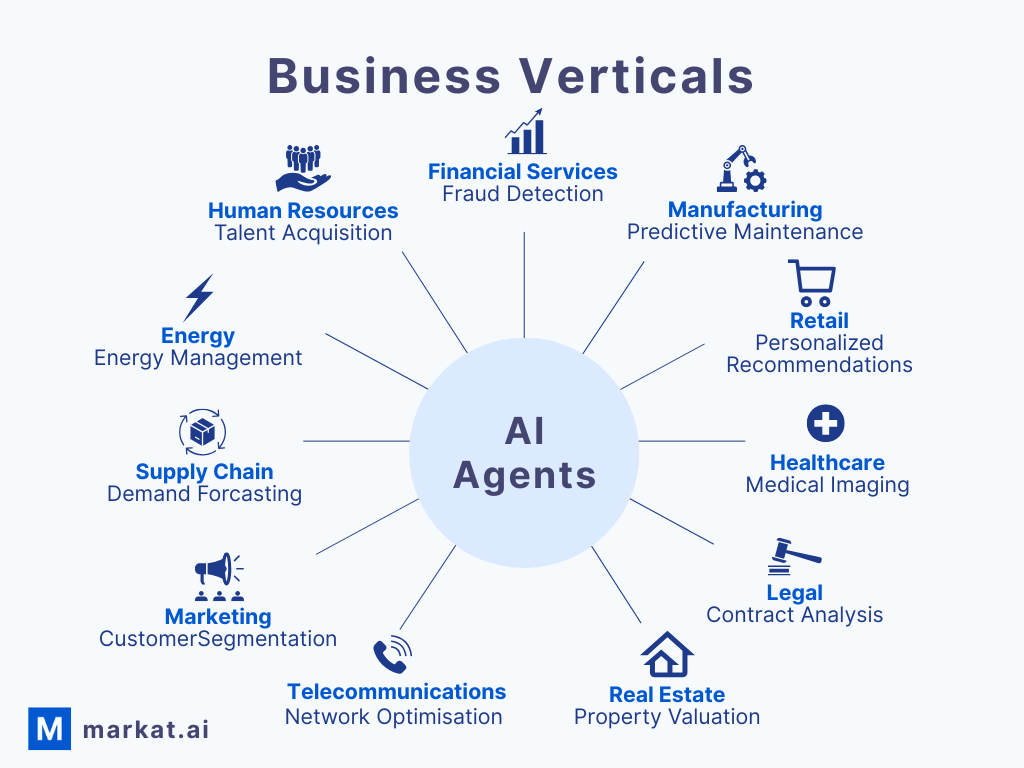
AI agents are already embedded in business-critical workflows across industries.
Customer-Facing Work
- Handling support requests autonomously
- Routing and resolving issues based on urgency and context
- Maintaining consistent service quality at scale
Revenue and Growth
- Qualifying leads and initiating first-contact outreach
- Running and optimizing campaigns through continuous testing
- Managing data-driven decision loops tied to performance
Internal Operations
- Summarizing meetings and documents
- Managing internal workflows and approvals
- Monitoring systems and flagging anomalies
These agents operate continuously, adapt to changing conditions, and reduce the need for manual intervention.
What AI Agents Are Not
AI agents are often misunderstood. They are not:
- Simple chatbots that only respond to user prompts
- Scripted automations that follow fixed rules without adaptation
- Self-aware or emotionally intelligent systems
AI agents are goal-driven software systems designed for autonomy and decision making, not artificial consciousness.
Why AI Agents Matter Now
AI agents mark a shift from static automation to systems that can operate, adapt, and improve on their own.
For organizations, this changes how work scales. Tasks that once required constant oversight can now be handled continuously, with agents making decisions in real time and adjusting as conditions change. This reduces operational friction and allows teams to focus on higher-value work.
The challenge in 2026 is no longer whether AI agents are viable. It is how to validate them, deploy them responsibly, and connect them to real business outcomes.
The Role of Marketplaces in the AI Agent Ecosystem
As AI agents become easier to build, discovery and validation have become the real constraints.
Developers need structured ways to test agents, gather feedback, and understand whether a solution solves a real problem. Businesses need confidence that agents are reliable, practical, and fit for production use.
Marketplaces focused on evaluation, testing, and distribution help bridge this gap by connecting builders with real users and real use cases, turning experimentation into deployable solutions.
Bottom Line
An AI agent is software that can observe its environment, make decisions, and act autonomously to achieve a goal.
In 2026, AI agents are no longer experimental. They are operational systems already shaping how work is done across products, teams, and organizations. Understanding what qualifies as an AI agent, and what does not, is now a baseline requirement for builders, leaders, and decision makers.
FAQ
What is an AI agent?
An AI agent is software that can observe inputs, make decisions, and perform actions autonomously to achieve a defined goal.
Is ChatGPT an AI agent?
No. ChatGPT is an AI tool that responds to user prompts. On its own, it does not operate autonomously or take actions without direct input. It can be part of an AI agent, but it is not an agent by itself.
What does an AI agent do?
An AI agent monitors inputs, decides what action to take based on context and goals, and executes tasks across systems or tools without continuous human oversight.
Can AI agents replace employees?
AI agents automate repetitive and operational work. They are used to support teams by freeing people to focus on higher-value, creative, or strategic tasks.
What makes an AI agent good or bad?
Effective agents operate reliably, adapt based on outcomes, and integrate smoothly into real workflows. Poor agents require constant supervision or fail to deliver measurable value.
What are the main types of AI agents?
AI agents are commonly grouped into reactive agents, limited-memory agents, tool-using agents, multi-agent systems, and human-in-the-loop agents. Each type is suited to different levels of autonomy, risk, and complexity.
How do AI agents know what to do?
AI agents operate based on defined goals, context from their environment, and decision logic that evaluates possible actions. They use feedback from outcomes to adjust future behavior.
What is the main task of an AI agent?
The main task of an AI agent is to achieve a goal autonomously by observing inputs, deciding on actions, and executing those actions without constant human oversight.